


3 Days at Anchor Without Starting Your Engine: Marine Power Autonomy
Dropping anchor in a secluded bay for a long weekend is the ultimate boater’s dream. Clear waters, quiet evenings, and total tranquility—until the low-battery alarm sounds on your vessel’s monitor.
For years, the standard routine for boaters staying anchored for two or three days was predictable: run the engine or auxiliary generator every morning and evening for a couple of hours just to keep the house batteries alive. This meant noise, exhaust fumes, unnecessary fuel burn, and engine wear—completely ruining the peace of the anchorage.
Achieving true electrical independence on a boat is no longer a luxury reserved for mega-yachts. With the right combination of Lithium Iron Phosphate (LiFePO4) batteries, high-efficiency marine solar panels, and smart power management, you can comfortably stay anchored for 3 days or more without turning your key once.
The Daily Onboard Energy Consumption Reality
To build an off-grid power setup that works under real-world sea conditions, you first need to audit your daily energy draw. Below is a breakdown of what a typical 7–12 meter boat consumes over a 24-hour period at anchor:
- Marine Refrigerator (12V compressor): Runs intermittently throughout the day and night. It remains the largest single energy consumer onboard, drawing 35–50 Ah daily depending on ambient ambient summer temperatures.
- GPS Plotter & Fishfinder / Sonar: Kept running for anchor watch monitoring, depth alarms, or fishing preparation. Draws 12–25 Ah daily.
- Onboard LED Lighting & Cabin Lights: Essential for night visibility and cabin comfort. Draws 5–10 Ah daily.
- USB Ports & Device Charging: Charging phones, tablets, handheld VHF radios, and cameras. Draws 8–15 Ah daily.
- Pure Sine Wave Inverter: Running household conveniences like coffee makers, laptop chargers, or small appliances. Draws 15–30 Ah daily depending on usage.
Total Estimated Daily Demand: ~85 to 130 Ah (at 12V).
Over 3 days, your total power demand reaches approximately 255 to 390 Ah.
Why Traditional AGM & GEL Batteries Fall Short
In a standard dual-battery lead-acid set up (AGM or GEL), staying anchored for 3 days without running the engine usually results in dead batteries or severe cell degradation.
- The 50% Usable Capacity Limit: Lead-acid batteries cannot be discharged below 50% without suffering permanent damage. A 200Ah AGM bank actually yields only 100Ah of usable power.
- Voltage Sag: As lead-acid batteries discharge, their voltage drops quickly, causing marine refrigerators and sensitive electronics to trigger low-voltage shutoffs long before the battery is fully empty.
- Slow Acceptance Rate: AGM and GEL batteries take a long time to absorb the final 20% of charge, making short engine-running cycles wildly inefficient.
The Solution: The LiFePO4 + Marine Solar Advantage
To eliminate engine idling completely, your onboard power system requires two components working in harmony: dense, deep storage and continuous renewable replenishment.
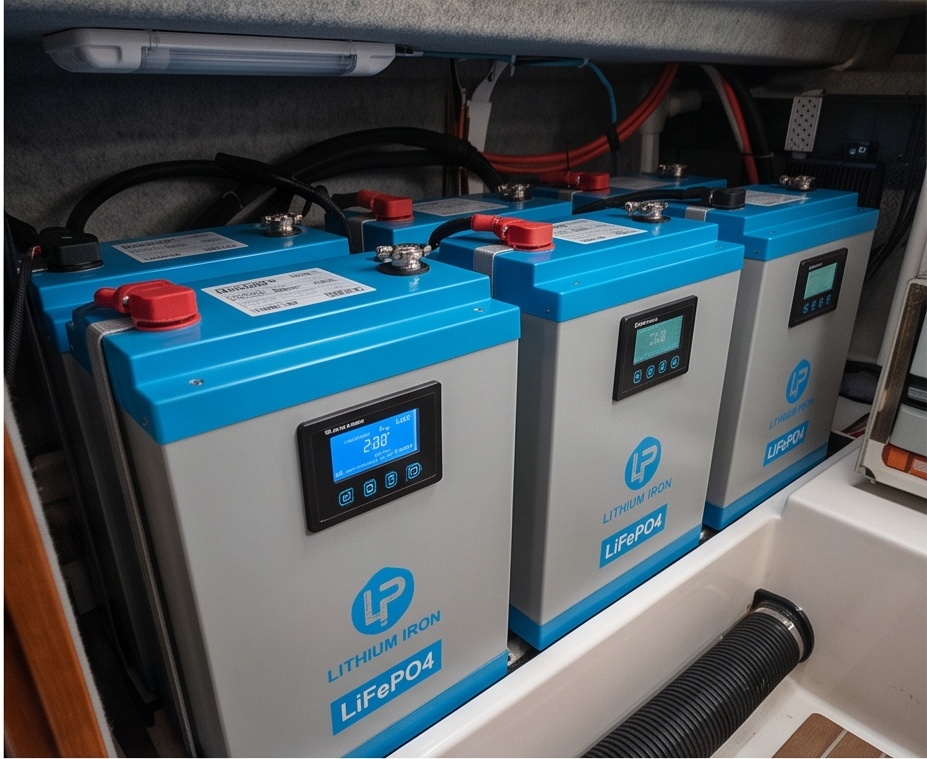
1. Lithium Iron Phosphate (LiFePO4) House Banks
- 100% Usable Capacity: Unlike AGM, you can safely discharge LiFePO4 up to 80–90% (and even 100% in emergencies) without degrading the cells. A 200Ah LiFePO4 battery provides up to 180–200Ah of real usable power.
- Flat Discharge Curve: Lithium holds a steady 12.8V–13.2V output right up until it is nearly depleted. Your marine fridge, audio systems, and electronics will run smoothly without glitching.
- Massive Weight & Space Savings: A LiFePO4 bank weighs up to 70% less and takes up significantly less space than an equivalent AGM setup—a crucial factor for vessel performance and trim.
2. Sized Marine Solar Panels & MPPT Controllers
While a LiFePO4 bank holds enough raw energy to cover your baseline, adding marine solar panels converts your system from “extended battery life” into infinite energy autonomy.
- Continuous Replenishment: A 200W–300W rigid or flexible marine solar panel array generates 60–110 Ah per day in typical Mediterranean summer sun.
- Smart MPPT Regulation: Paired with an MPPT (Maximum Power Point Tracking) charge controller (such as Victron SmartSolar), solar efficiency increases by up to 30%, capturing every available watt even during partial morning or evening shading.
Sample Autonomy Setup: The 3-Day Anchoring System
For a vessel aiming to achieve 100% silent, engine-free anchoring, a baseline system configuration includes:
| Component | Standard Setup | Upgraded Autonomy Setup |
| House Battery | 2x 100Ah AGM (100Ah usable) | 1x 200Ah or 2x 100Ah LiFePO4 (180–200Ah usable) |
| Solar Generation | None or 50W trickle charger | 200W – 350W Solar Panels + MPPT Controller |
| Battery Monitoring | Basic Analog Voltmeter | Smart Shunt / Bluetooth Battery Monitor |
| Engine Charging | Standard Alternator | DC-DC Charger (protects alternator & charges LiFePO4 safely) |
| Result | Engine required daily (1–2 hrs) | 3+ Days Pure Autonomy (Zero Engine Hours) |
Upgrade Your Onboard Power with Pharos Marine
Transitioning your vessel to lithium and solar requires proper system design, correct wiring gauges, and certified installation to ensure safety and system longevity under harsh marine conditions.
At Pharos Marine Electronics, our team of marine technical experts specializes in complete onboard electrical evaluations, Victron Energy system integrations, custom LiFePO4 bank upgrades, and marine solar fitting. Contact us to discuss a custom off-grid power setup for your boat.