


A Captain’s Guide to Marine VHF Radios: Handheld vs Fixed
Read this guide for marine VHF radio and you’ll know whether a handheld, a fixed unit or a fixed+handheld combo is right for your boat; which features truly matter at sea; which models match mission and budget; and a short buying + installation checklist you can use in the shop or on your tender. If you want help selecting, programming or fitting the radio, Pharos Marine Electronics in Greece is an authorized dealer that sells, programs and installs the VHF radios discussed.
Handheld or fixed: choose by mission, not by brand
The operational trade-off is simple. Fixed-mount radios push up to 25 W, sit on the vessel’s 12V supply and use a masthead antenna. That equals reliable long-range voice and DSC reach when antenna height is available. Handheld units are self-contained: 5–6 W transmit, internal battery and antenna, and they float; they are vital as a backup and unbeatable for tenders or as an emergency lifeline if the boat loses power. In practice, antenna height often matters more than a single watt of transmit power—line-of-sight wins.
Scenario recommendations
Tenders & dinghies: handheld only. Choose a floating handheld with strobe and good waterproofing so the person in the water still has a usable radio.
Dayboats / coastal cruisers: handheld is often sufficient, but a fixed 25 W with a masthead antenna plus a handheld backup is the safer choice when you cross busy channels or rely on shore services.
Bluewater yachts: fixed 25 W primary plus a robust handheld backup is the right approach; integrate DSC/AIS on the fixed unit and keep the handheld in the cockpit and the tender.
Commercial / charter vessels: fixed-mount primary is typically mandated by regulations and safety practices; handhelds are required as portable backups for boarding, inspections and tenders.
Quick decision rule
Answer three questions: Where will you go (harbour, coastal, offshore)? How many people depend on you? Do you need integrated AIS/DSC into your navigation network? Mostly harbour/day use = handheld. Regular coastal work or multiple crew = fixed + handheld. Offshore, commercial or charter = fixed mandated, handheld as backup.
Features that actually matter at sea
Drop the alphabet soup unless it solves a problem. Here’s what to care about and why.
DSC (Digital Selective Calling)
DSC sends an automated distress message on Channel 70 including your MMSI and—if the radio has GPS—your coordinates. That alone shortens response time. Without GPS, a DSC distress is less useful. Register an MMSI and have it programmed into the unit before you go to sea. Example: DSC lets you send a single, location-bearing distress to coast stations and nearby vessels while you prepare a voice broadcast.
AIS: receiver vs transponder
An AIS receiver shows nearby traffic on your chartplotter; a transponder (Class B for recreational boats) broadcasts your position to others. On busy approaches and shipping lanes AIS shifts from “nice-to-have” to essential. If you regularly transit commercial traffic, choose a fixed VHF with AIS receive or pair the radio with a dedicated AIS unit on the NMEA network.
NMEA 2000 and integration
NMEA 2000 is the plug-and-play backbone that shares GPS, DSC alarms and AIS targets between radio, chartplotter and instruments. A DSC distress triggered from a chartplotter or cockpit button saves seconds and reduces error; that’s why radios that speak NMEA 2000 simplify real-world rescues and collision avoidance.
IP rating and flotation
IPX7/IPX8 or IP67 ratings mean the radio will survive spray and short immersion. For small-boat and tender use, flotation plus an automatic strobe is essential; for fixed helm radios, an IP67 display protects against spray and rain.
Power and battery
Wattage determines potential range, but antenna height and line-of-sight govern actual performance. A handheld’s independent battery is the definitive fail-safe when ship power is lost—so every vessel should carry at least one floatable handheld even when a fixed radio is installed.
Best current radios by use-case and budget
Two practical tiers: premium & mid-range budget. Match features to mission rather than prestige.
Handhelds
- Icom M92D / M94D — Premium picks; the M94D adds AIS. Choose these if you want top-tier ergonomics, reliable DSC/GPS and the option of AIS in a handheld form.
- Icom IC-M37E VHF transceiver — Mid-range: compact, floating with immersion strobe. Good for tenders and small-boat owners who value visibility and simplicity.
For product selection and a broader range of handhelds, see our Marine VHF Radio & Communications category.
Fixed-mount VHF
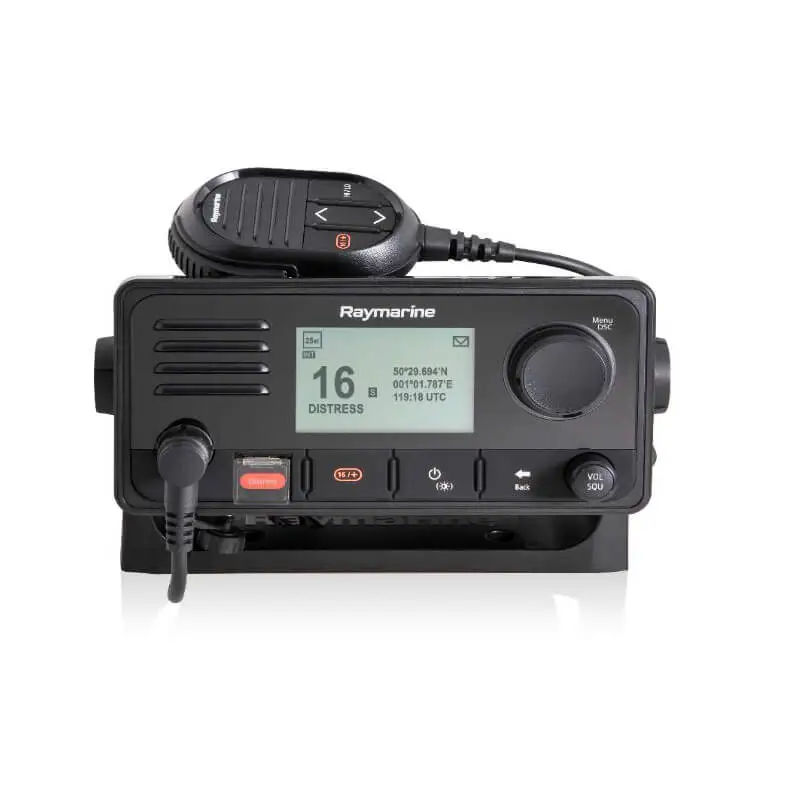
- Raymarine Ray53 VHF Radio & Icom IC‑M330GE — From compact to premium: built-in GPS and DSC; the
- Ray 63, 73, 90/91 — Best for yachts wanting integrated AIS systems and MFD connectivity (Ray 91 only). Pick these when you want AIS overlays on chartplotters without separate AIS hardware.
Pairing advice: for any boat larger than a small dayboat, a 25 W fixed unit mounted with a proper masthead antenna as primary plus a floatable handheld backup is the resilient standard. For tenders, prioritize float, strobe and waterproofing.
Antennas, installation and NMEA integration. Plan this before you buy.
Common marine electronics installation mistakes are predictable and avoidable. Plan the antenna and wiring first; it determines the system’s real-world performance.
Antennas: height is king. Mount the VHF antenna as high and clear as practical. Use a dedicated marine VHF antenna—don’t compromise with a multi-band trunk or fishing-rod style aerial for long-range work.
Feedline & connectors: use low-loss 50 Ω coax. Match connector types to the radio and use professional crimps and silicone sealant on through‑deck fittings. See our Marine Electronics Parts for feedline, connectors and deck fittings.
Wiring & protection: put an inline fuse or circuit breaker on the positive feed, follow the manufacturer’s wire‑gauge recommendations and ensure proper bonding. These steps protect both the radio and the vessel.
NMEA 2000 & DSC/GPS wiring: design a backbone with a single drop per device, correct terminators and power injection points. A radio with built-in GPS simplifies DSC distress calls and reduces wiring complexity.
Testing and commissioning: a professional sea‑trial should include transmit/receive checks at range, a DSC call test to a coast station or test number, and chartplotter integration verification for AIS and position data.
Pharos note: Pharos Marine Electronics offers inspection, supply, professional mounting, NMEA setup, MMSI programming and commissioning as part of their installation packages. Work with an authorized dealer for genuine parts and warranty-backed installation — Pharos stocks the brands above and supports installations.
Legal must-dos and MMSI/DSC registration
DSC radios should be programmed with an MMSI. Recreational users can obtain a domestic MMSI via registrars; international or commercial operations requireFCC radio licenses and filings through the appropriate channels.
EU/UK and Greece: many EU states and the UK require a ship station licence and an operator certificate (e.g., SRC or RYA VHF). Greece follows EU directives; contact the Hellenic Coast Guard for national details. For charters, marinas and rental companies often insist on proof of competence and properly registered MMSI/DSC equipment.
Programming: register an MMSI, keep the paperwork safe, and have the number programmed into the radio before first use. Pharos can assist local customers with MMSI programming and paperwork.
Compact buying + installation checklist
- Choose fixed or handheld (or both) based on your mission and the three-question rule above.
- Confirm DSC capability and built-in GPS if you want automated distress positions.
- Decide whether you need AIS receive or a transponder.
- Check IP rating and flotation for tender/small-boat use.
- Budget for a proper masthead antenna and low-loss feedline.
- Plan NMEA 2000 connection for chartplotter and alarm integration.
- Register an MMSI and program it into the radio before first voyage.
- Book a professional install or follow manufacturer wiring and fuse guidance precisely.
- Sea-trial: verify DSC test call, VHF range and chartplotter integration.
Final recommendations and next step
Short version: dayboat — a floatable handheld with strobe; coastal cruiser — a 25 W fixed with a handheld backup; offshore/yacht — premium fixed with AIS plus handheld; commercial — fixed with redundancy and professional installation. Every boat benefits from a registered MMSI and a DSC test before leaving harbour.
If you’d like hands-on help, Pharos Marine Electronics stocks the brands above, provides authorised installations and programming, offers free delivery over €300, secure payments and a seven‑day money‑back guarantee. Contact Pharos for a personalised recommendation and to book an inspection and sea‑trial so your new radio is ready the moment you step aboard.