


Never Run Out of Battery on a Boat: Complete Marine Power Guide
Few moments on the water cause as much sudden anxiety as turning the ignition key and hearing a hollow, sluggish click. Whether you are anchored in a quiet cove or navigating back to port at dusk, running out of electrical power on a boat or yacht is more than a mild inconvenience—it is a critical safety hazard.
Modern boats are packed with power-hungry electronics: large dual-screen chartplotters, high-draw CHIRP sonars, electric windlasses, marine refrigeration, dynamic LED lighting, and inverter systems powering everyday appliances. Without a properly balanced electrical ecosystem, traditional marine battery setups quickly collapse under the load.
This guide breaks down the core reasons boat batteries fail, the exact equipment needed to fix the problem permanently, and how a modern system built around LiFePO4 lithium batteries, solar generation, and SmartShunt battery monitoring guarantees total energy independence at sea.
The Problem: Why Boat Batteries Constantly Die
To fix power outages on a vessel, you must first understand why traditional marine electrical systems fail.
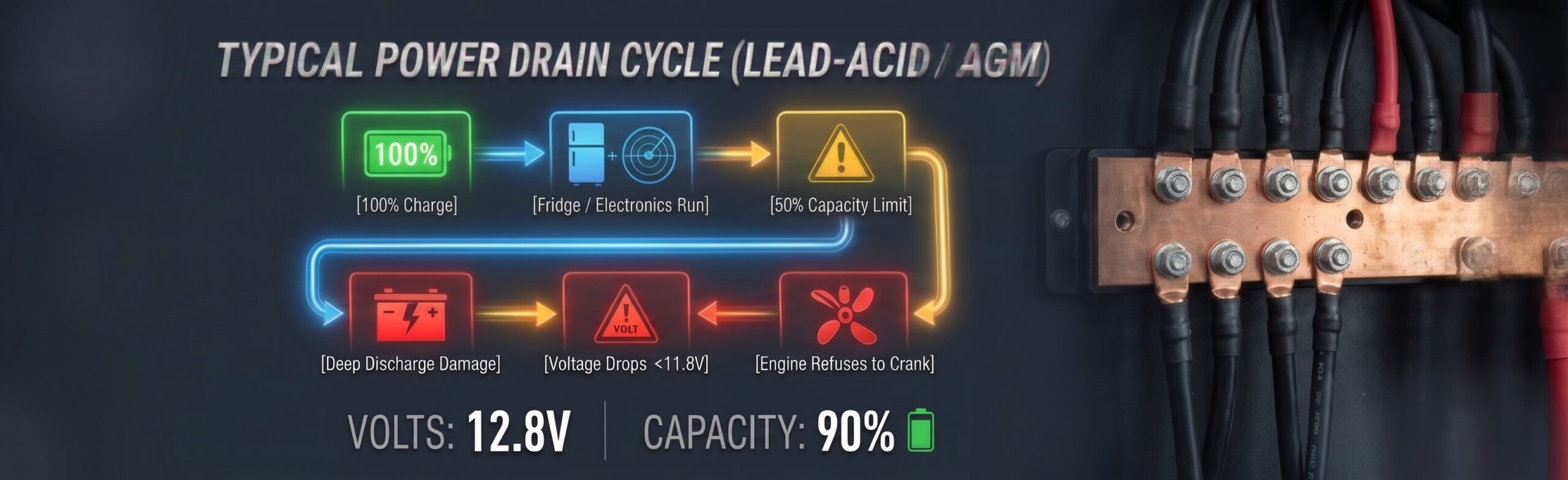
1. The “50% Depth of Discharge” Trap
Traditional Lead-Acid, Gel, and AGM batteries carry a major hidden flaw: you can only use 50% of their rated capacity. Discharging an AGM battery below 50% state of charge (SoC) causes rapid irreversible sulfation, ruining its lifespan and drastically lowering its voltage output. If you have a 100Ah AGM battery, you actually only own a 50Ah battery.
2. Slow Acceptance Rates & Peukert’s Law
Lead-acid chemistries absorb charge very slowly as they fill up. The final 20% of charging (the absorption phase) can take hours of continuous engine idling. Most boat owners turn off their engines long before the battery bank reaches a true 100% charge, leading to a chronic cycle of undercharging.
3. Phantom Inverter & DC Power Drains
Leaving a 230V inverter idling without an active AC load still consumes 1 to 2 Amps per hour just staying awake. Add an unmonitored anchor alarm, livewell pumps, and a cycling 12V fridge, and your house bank can drain completely overnight without your knowledge.
The Solution: A Modern 4-Pillar Marine Power Architecture
To eliminate battery anxiety completely, your vessel needs a balanced multi-source generation and storage network designed around four core components.
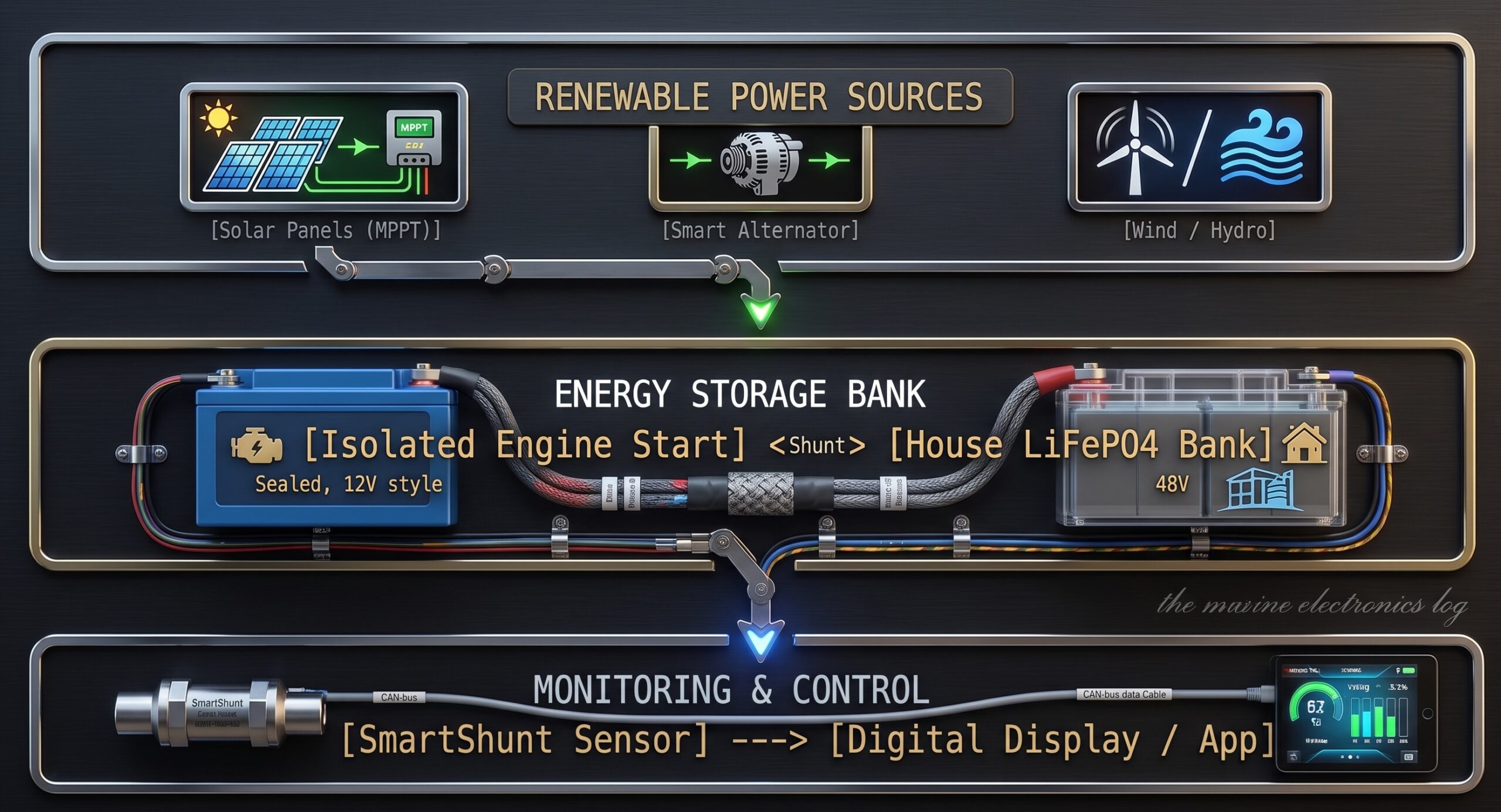
Pillar 1: Energy Storage — Upgrade to LiFePO4 Lithium
The single most impactful upgrade you can make to your boat’s power system is replacing traditional house batteries with Lithium Iron Phosphate (LiFePO4) chemistry.
| Feature | Lead-Acid / AGM | LiFePO4 Lithium |
| Usable Capacity | 50% of rated Ah | Up to 90%–95% of rated Ah |
| Weight | Very Heavy (~30 kg per 100Ah) | Ultra Light (~11 kg per 100Ah) |
| Charge Speed | Slow (4–8 hours full cycle) | Ultra Fast (1–2 hours full cycle) |
| Voltage Stability | Drops rapidly as it discharges | Flat 12.8V–13.2V curve until empty |
| Lifespan | 300–500 cycles | 3,000–5,000+ cycles |
Crucial Safety Rule: Dual Bank Isolation
Never connect your engine ignition to your house battery bank. A professional installation splits your vessel into two isolated systems:
- Dedicated Engine Start Bank: AGM battery kept purely for cranking the main engine or generator.
- LiFePO4 House Bank: Handles all domestic loads, electronics, pumps, and inverters.
- Automatic Charging Relays (ACR / DC-DC Chargers): Ensures both banks charge from the engine alternator while keeping them electronically separated so domestic power use can never drain your starter battery.
Pillar 2: Real-Time Intelligence — Battery Monitors & SmartShunts
You cannot manage what you do not measure. Voltmeter gauges on old dash panels are notoriously misleading because battery voltage fluctuates based on active loads. Reading 12.2V under load does not tell you how much energy remains in your bank.
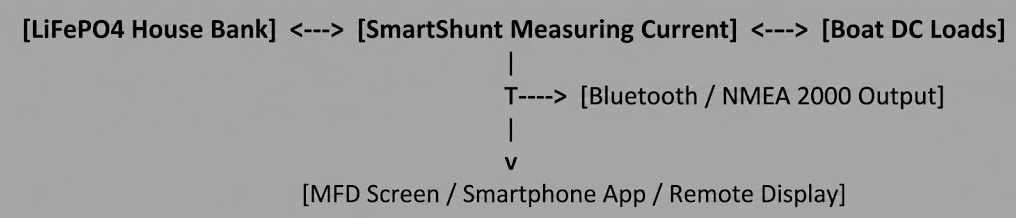
What is a SmartShunt?
A SmartShunt is an ultra-precise electronic current sensor installed directly on the main negative terminal of your house battery bank. It measures every single milliamp entering or leaving your batteries.
Key Data Provided by a SmartShunt System:
- True State of Charge (SoC %): Displays remaining fuel-gauge-style percentage (e.g., 78% Remaining).
- Time Remaining: Dynamically calculates how many hours or days your battery will last based on your current power consumption rate.
- Historical Data: Tracks deep discharge events, total energy consumed, and charge cycles to protect your battery warranty.
By pairing a SmartShunt with your chartplotter display via NMEA 2000 or viewing it on a smartphone app via Bluetooth, you know instantly if a fridge door was left open or if an inverter was left running in secret.
Pillar 3: Multi-Source Power Generation
Relying solely on your boat’s engine alternator to charge batteries is noisy, inefficient, and puts unnecessary hour wear on your propulsion mechanics. A truly autonomous boat combines multiple generation sources:
- Marine Solar Panels: Installing rigid or flexible solar panels on your hardtop, bimini, or arch provides continuous, silent power during daylight hours. Combined with a Maximum Power Point Tracking (MPPT) solar controller, a 300W–600W solar array can completely cover the daily energy draw of a marine fridge, lighting, and onboard electronics without starting the engine once.
- High-Output Smart Alternators & DC-DC Chargers: Stock engine alternators are designed to charge starting batteries, not massive lithium house banks. Installing a specialized DC-DC battery charger or high-output alternator ensures high-speed, safe current transfer from the engine to your lithium bank without overheating the alternator.
- Wind & Hydro Generators: For ocean passage makers and sailboats anchored in windy regions, small marine wind turbines and towed hydro-generators provide invaluable night-time and underway power generation.
Pillar 4: Power Management & Consumption Optimization
Even the largest lithium bank will run dry if energy management habits are ignored. Adopting smart onboard practices drastically extends your time off-grid:
- Upgrade 100% of Lighting to LED: Halogen bulbs draw up to 20W each, whereas equivalent marine LEDs draw under 2W.
- Manage Inverter Idle Draw: Turn off your 230V inverter from its remote panel whenever you are not actively using high-voltage appliances like espresso machines, laptops, or hairdryers.
- Optimize Marine Refrigeration: Ensure door gaskets seal tight, install extra insulation around custom fridge boxes, and avoid placing warm drinks into the fridge late at night.
- Isolate Heavy Anchor Watch Electronics: Avoid running full dual 12-inch MFD chartplotters overnight just to run an anchor drift alarm. Use low-draw standalone instruments or dedicated smartphone anchor monitoring apps instead.
Engineer Your Ultimate Marine Electrical System with Pharos Marine
Building a marine electrical setup that never fails requires careful load calculations, high-grade marine wiring, correct fuse protection, and precise component matching. Improperly installed lithium systems or un-fused solar lines present real electrical and fire risks in harsh saltwater environments.
At Pharos Marine, we specialize in designing, supplying, and installing high-performance marine power systems tailored to your boat’s specific needs.
Our certified marine technicians provide:
- Custom Electrical Load Audits: We calculate your exact daily Ah consumption to size your system correctly.
- LiFePO4 & SmartShunt Conversions: Safe, professionally wired lithium battery upgrades with isolated engine starting networks.
- Solar & MPPT Integration: Seamless roof and arch solar installations engineered for marine environments.
- NMEA 2000 Integration: Route battery monitor data directly to your Raymarine Axiom displays for full helm visibility.
Ready to eliminate battery anxiety and enjoy true off-grid freedom at sea? Explore our full range of marine power equipment at PharosMarine.eu or contact our technical team today to schedule your marine electrical refit.