


How to Design a Reliable Off-Grid Marine Electrical System with Victron Energy
Whether you’re planning extended cruising, spending weekends at anchor, or operating a commercial vessel, your onboard electrical system plays a critical role in both comfort and safety.
Today’s boats rely on far more than basic lighting and navigation equipment. Refrigeration, chart plotters, radar, autopilots, communication systems, entertainment devices, watermakers, induction cooktops and air conditioning all demand a reliable source of power. A poorly designed electrical installation can lead to discharged batteries, unreliable equipment, excessive generator use and expensive repairs.
This is why designing a modern marine electrical system isn’t simply about installing larger batteries or adding more solar panels. Every component must be carefully selected so the entire system operates efficiently as one integrated solution.
Victron Energy has become one of the world’s leading manufacturers of marine power systems because its products are designed to work together seamlessly. Combined with proper engineering, they provide exceptional reliability, energy efficiency and complete visibility over your vessel’s electrical installation. In this guide, we’ll explain the key building blocks of a modern off-grid marine electrical system, how they interact and the factors you should consider before choosing any equipment.

Why More Boat Owners Are Moving Towards Off-Grid Electrical Systems
Until a few years ago, most vessels depended heavily on shore power or diesel generators. Today, things have changed dramatically.
High-efficiency lithium batteries, intelligent inverter/chargers, advanced battery monitoring and solar charging technologies allow many boats to remain completely self-sufficient for days—or even weeks—without connecting to shore power.
A properly engineered off-grid system offers significant advantages:
- Reduced generator operating hours
- Lower fuel consumption
- Silent operation while at anchor
- Greater onboard comfort
- Longer battery lifespan
- Continuous power for critical navigation equipment
- Increased vessel value
- Lower maintenance costs over time
Rather than thinking of your electrical installation as individual products, it’s better to think of it as a complete energy ecosystem where every component communicates and works together.
What Does a Modern Marine Electrical System Include?
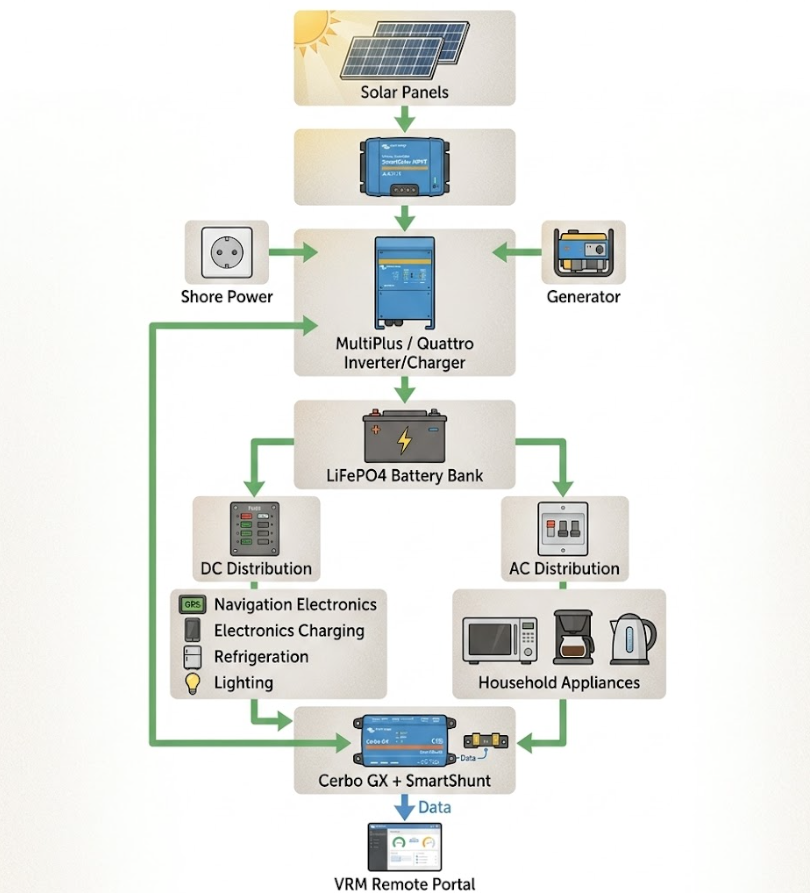
Every vessel is different, but most modern installations follow the same architecture.
Energy enters the system from multiple charging sources before being stored inside the battery bank. From there, it is distributed safely to both DC and AC consumers while continuously monitored by intelligent control systems.
Designing the System Before Buying Equipment
One of the biggest mistakes boat owners make is choosing equipment before calculating their actual energy requirements.
It’s common to see expensive inverter/chargers installed alongside battery banks that are too small—or oversized solar arrays charging batteries that can’t store the available energy. A properly designed system always begins with understanding how electricity is consumed onboard.
Professional marine electrical engineers typically evaluate:
- Vessel type
- Cruising style
- Time spent at anchor
- Average daily consumption
- Peak AC loads
- Available installation space
- Existing charging sources
- Future equipment upgrades
Only after these factors are understood should the system be designed. This approach ensures every component works efficiently while avoiding unnecessary costs.
Step 1 – Calculate Your Daily Energy Consumption
Before selecting batteries or inverters, you need to know how much energy your boat actually uses every day. This is often called an energy audit, and it forms the foundation of every successful electrical installation.
Instead of guessing, list every electrical device onboard together with:
- Power consumption (Watts)
- Daily operating hours
- Daily energy usage (Wh)
For example:
| Equipment | Power | Hours / Day | Daily Consumption |
| Refrigerator | 70 W | 12 h | 840 Wh |
| Cabin Lighting | 45 W | 6 h | 270 Wh |
| Chart Plotter | 40 W | 8 h | 320 Wh |
| Autopilot | 55 W | 7 h | 385 Wh |
| Radar | 45 W | 5 h | 225 Wh |
| VHF Radio | 8 W | 12 h | 96 Wh |
| Laptop Charging | 90 W | 3 h | 270 Wh |
| Water Pump | 60 W | 0.5 h | 30 Wh |
Estimated daily consumption: 2,436 Wh
Of course, every vessel is different. A weekend cruiser may consume less than 2 kWh per day, while a liveaboard sailing yacht with refrigeration, cooking appliances and a watermaker can easily exceed 8–10 kWh daily. This calculation determines almost every other component of your system.
Understanding Peak Loads vs Daily Consumption
Daily energy usage tells you how much electricity you need. Peak load tells you how much power your inverter must deliver instantly. These are completely different values.
For example:
| Appliance | Power |
| Coffee Machine | 1,500 W |
| Microwave | 1,200 W |
| Hair Dryer | 1,800 W |
| Water Heater | 1,500 W |
Although these appliances may only run for a few minutes each day, they determine the minimum inverter size.
This is why professional system sizing always considers:
- Continuous load
- Peak load
- Simultaneous operation
- Future expansion
Ignoring peak loads is one of the most common causes of inverter overload.
Step 2 – Choosing the Right Battery Technology
Your battery bank is the heart of the entire electrical system. Every charging source feeds it. Every onboard appliance depends on it.
Choosing the right battery technology has a direct impact on autonomy, charging efficiency and long-term operating costs. While AGM batteries remain common on older vessels, lithium iron phosphate (LiFePO4) technology has become the preferred solution for modern marine installations.
Why LiFePO4 Batteries Have Become the New Standard
Compared with traditional lead-acid batteries, LiFePO4 batteries offer significant advantages.
Longer lifespan
Most quality lithium batteries can deliver over 3,000–6,000 charge cycles, several times more than conventional AGM batteries.
Higher usable capacity
Lead-acid batteries should rarely be discharged below 50%.
LiFePO4 batteries can safely operate at 80–90% depth of discharge, allowing more usable energy from the same rated capacity.
Faster charging
Lithium batteries accept much higher charging currents, dramatically reducing charging time from alternators, generators or shore power.
Lower weight
Weight savings are particularly valuable on sailing yachts and performance vessels.
Stable voltage
Unlike lead-acid batteries, lithium batteries maintain a nearly constant voltage throughout most of their discharge cycle, ensuring onboard equipment operates consistently.
Sizing Your Battery Bank Correctly
Battery capacity should never be selected based solely on available space or budget.
Instead, it should be calculated using:
- Daily energy consumption
- Desired autonomy
- Charging sources
- Safety reserve
- Future expansion
For example, a vessel consuming approximately 3 kWh per day and requiring two days of autonomy without shore power will need a significantly larger battery bank than a boat that returns to the marina every evening.
Professional system designers also consider seasonal conditions, cloud cover, cruising locations and charging opportunities before recommending the final battery capacity.
This engineering-first approach results in a system that remains reliable in real-world operating conditions rather than only under ideal circumstances.
Step 3 – Selecting the Right Inverter/Charger
Once you’ve determined your energy consumption and battery capacity, the next step is selecting the heart of your AC power system: the inverter/charger. An inverter converts the DC power stored in your batteries into 230V AC electricity, allowing you to operate household appliances while away from shore power.
A charger performs the opposite task, safely recharging your batteries whenever the vessel is connected to shore power or a generator. Modern Victron Energy inverter/chargers combine both functions into a single intelligent unit, simplifying installation while maximizing efficiency.
For most recreational and professional vessels, this becomes the central hub of the entire electrical system.
Victron MultiPlus vs Victron Quattro
One of the most common questions boat owners ask is whether they should choose a Victron MultiPlus or a Victron Quattro. The answer depends on how the vessel will be used.
Victron MultiPlus
The MultiPlus combines:
- Pure sine wave inverter
- High-performance battery charger
- Automatic transfer switch
It is the ideal solution for most sailing yachts, motor yachts and cruising vessels where the electrical system is powered by either:
- Shore power
- Generator
- Battery bank
The MultiPlus automatically switches between available power sources while charging the batteries and supplying onboard AC loads. Its compact design and exceptional reliability have made it one of the most popular inverter/chargers in the marine industry.
Typical applications include:
- Weekend cruising
- Coastal cruising
- Liveaboard sailing yachts
- Catamarans
- Motor yachts
Victron Quattro
The Quattro is designed for larger and more demanding installations.
Unlike the MultiPlus, it can manage two independent AC inputs simultaneously, typically:
- Shore Power
- Generator
The system automatically selects the available source without user intervention, making it ideal for vessels where uninterrupted AC power is essential. Commercial vessels, expedition yachts and larger motor yachts often benefit from the Quattro’s additional flexibility and power handling capabilities.
Which One Is Right for Your Boat?
There is no universal answer.
The correct choice depends on factors such as:
- Total onboard power demand
- Battery bank capacity
- Generator size
- Shore power availability
- Future upgrades
- Space limitations
- Cruising habits
This is why professional system design always comes before product selection.
Choosing an inverter based solely on wattage often leads to unnecessary cost—or worse, an undersized system that struggles under real operating conditions.
Understanding PowerAssist
One of Victron Energy’s most valuable technologies is PowerAssist. Many marinas provide limited shore power, especially during peak season.
Running multiple onboard appliances simultaneously can easily exceed the available supply, causing breakers to trip. PowerAssist solves this problem automatically.
Whenever shore power becomes insufficient, the inverter instantly supplements the missing power using energy stored in the battery bank. Once demand decreases, the batteries are automatically recharged.
For example:
Imagine you’re connected to a marina supplying only 16A. At the same time, someone onboard switches on:
- Air conditioning
- Water heater
- Coffee machine
Instead of disconnecting the vessel, the MultiPlus temporarily provides the additional power required. The transition is seamless and completely automatic.
PowerControl Protects Your Shore Connection
Another intelligent feature is PowerControl.
Rather than waiting for the marina breaker to trip, the system continuously monitors incoming current. Users can define the maximum current available from shore power, and the inverter intelligently manages charging current to ensure the limit is never exceeded. This is particularly useful in older marinas where electrical infrastructure may be limited.
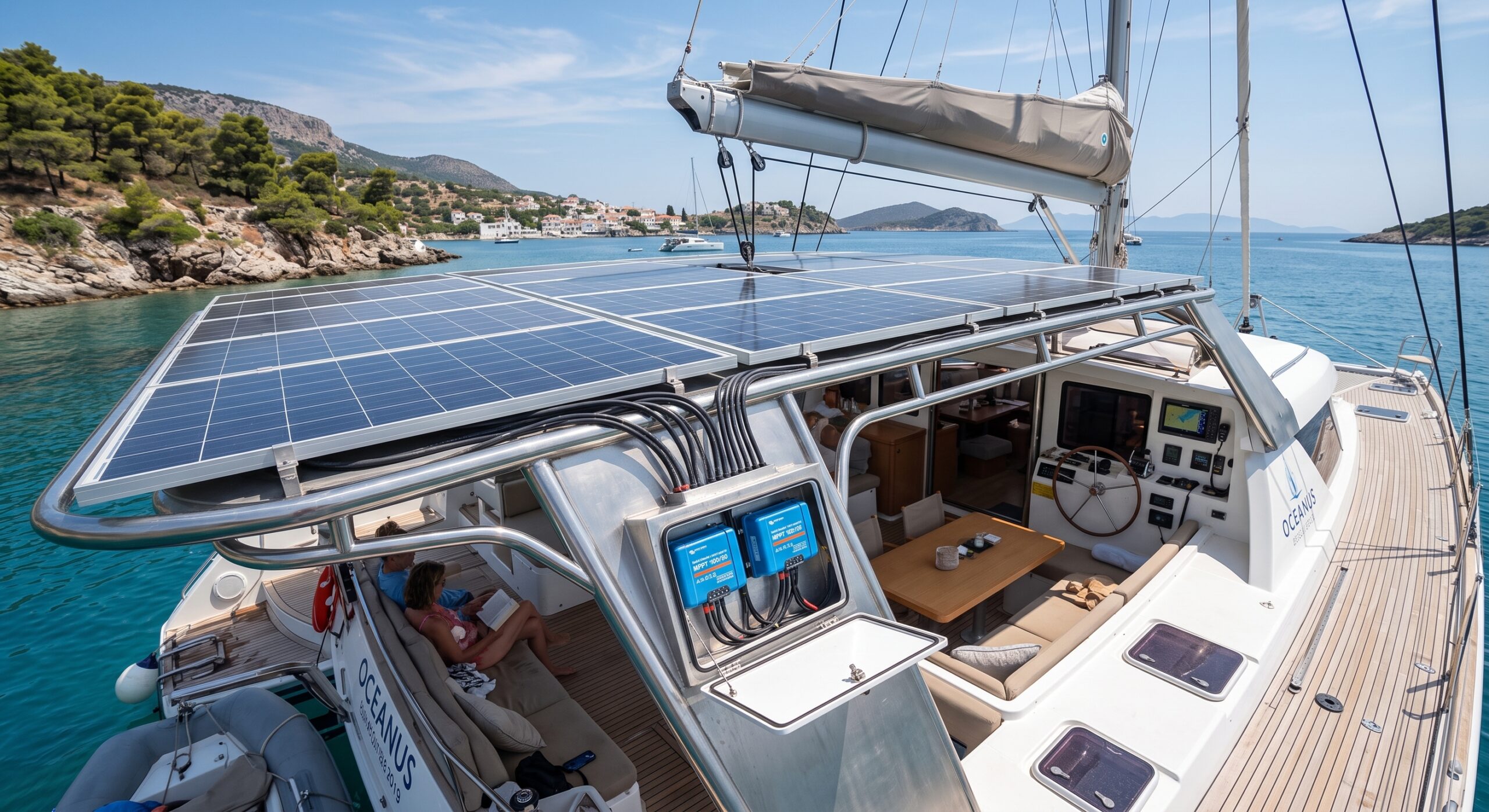
Step 4 – Harvesting Solar Energy with Victron SmartSolar MPPT
Solar energy has transformed modern boating. Instead of relying solely on alternators or generators, many vessels now generate a significant portion of their daily electricity directly from solar panels.
However, solar panels alone are only part of the equation. The real performance comes from the solar charge controller.
Why MPPT Technology Matters
Not all solar regulators are created equal. Older PWM controllers simply reduce panel voltage to match the battery voltage, wasting a considerable amount of available energy.
Victron SmartSolar MPPT controllers constantly calculate the optimal operating point of the solar panels, extracting the maximum possible power under changing weather conditions.
This means higher charging efficiency during:
- Cloudy weather
- Early mornings
- Late afternoons
- Partial shading
- Variable temperatures
Depending on installation conditions, MPPT technology can recover significantly more usable energy than traditional PWM controllers.
Correct Solar Sizing
A common misconception is that installing more solar panels automatically solves every energy problem. In reality, solar production depends on several variables.
These include:
- Geographic location
- Season
- Weather
- Panel orientation
- Available deck space
- Shading from sails, radar arches or masts
Professional designers evaluate all these factors before recommending the appropriate panel capacity. Oversizing the array without considering battery capacity or charging infrastructure may increase costs without delivering meaningful benefits.
Cable Sizing Is Just as Important
Even the highest-quality solar panels cannot compensate for poor installation practices.
Incorrect cable sizing creates voltage drop, reducing charging performance and wasting valuable energy. Marine electrical systems also operate in one of the harshest environments possible. Saltwater, vibration, humidity and temperature changes require marine-grade materials and proper protection throughout the installation.
Professional installers carefully select:
- Cable cross-sections
- Fuse ratings
- Isolation switches
- Waterproof connectors
- Cable routing
These details often determine the long-term reliability of the system.
Step 5 – Complete System Monitoring
One of the biggest differences between a traditional electrical installation and a modern Victron Energy ecosystem is visibility. Instead of guessing how much battery capacity remains, users can monitor the entire electrical system in real time.
Every charging source, battery, inverter and electrical load becomes measurable. This not only improves convenience but also helps prevent costly failures.
SmartShunt – Knowing Your Battery’s True State
Battery voltage alone provides very limited information. A battery can display healthy voltage while having significantly less usable capacity than expected.
The Victron SmartShunt continuously measures:
- Battery state of charge
- Current flow
- Remaining runtime
- Historical consumption
- Charging efficiency
This allows boat owners to make informed decisions about their energy usage instead of relying on estimates.
Cerbo GX – The Brain of the System
The Cerbo GX acts as the communication center of the entire installation. Rather than monitoring individual devices separately, it gathers information from every connected Victron component and presents it through one intuitive interface.
This includes:
- Battery status
- Solar charging
- Inverter operation
- Shore power
- Generator status
- Tank monitoring
- Temperature sensors
Everything becomes accessible from a single dashboard.
GX Touch – Control at Your Fingertips
The GX Touch display provides a simple graphical interface that can be installed at the helm or inside the cabin.
Boat owners can instantly view:
- Battery charge
- Solar production
- AC consumption
- DC loads
- Charging sources
- Alarms
Without opening electrical panels or connecting external devices. Its intuitive interface makes advanced energy management accessible even to users without technical expertise.
Remote Monitoring Through VRM
One of Victron Energy’s most powerful capabilities is the VRM Portal. By connecting the Cerbo GX to the internet, users can securely monitor their vessel remotely from anywhere in the world.
Whether the boat is in a marina, on a mooring or cruising abroad, the owner can view:
- Battery status
- Historical energy consumption
- Solar production
- Shore power connection
- Alarm notifications
- System performance trends
For commercial operators, fleet managers and long-distance cruisers, this level of visibility provides valuable peace of mind.
Step 6 – Protecting Your Marine Electrical System
Designing an efficient electrical system is only half the challenge. Ensuring that it operates safely for years in the demanding marine environment is equally important.
Saltwater, humidity, vibration, temperature fluctuations and confined installation spaces place unique demands on every electrical component. Even the highest-quality batteries and inverter/chargers cannot compensate for inadequate protection or poor installation practices.
A properly engineered marine electrical system should always include:
- Correctly sized fuses
- Marine-grade circuit breakers
- Battery isolation switches
- Busbars and distribution blocks
- Proper cable protection
- Emergency disconnect points
- Clearly labelled electrical circuits
Each protective device should be selected according to the system’s maximum current, cable size and the equipment it protects. Professional installations also consider accessibility. In the event of maintenance or an emergency, every critical component should be easy to isolate without dismantling large sections of the electrical system.
The Importance of Proper Cable Sizing
One of the most overlooked aspects of marine electrical design is cable sizing. It’s tempting to focus on expensive equipment such as lithium batteries or inverter/chargers, but the performance of the entire system depends on how those components are connected.
Undersized cables create excessive voltage drop, generate unnecessary heat and reduce charging efficiency. In severe cases, they can become a serious safety hazard.
Professional installers calculate cable size based on several factors, including:
- Maximum current
- Cable length
- Acceptable voltage drop
- Installation method
- Ambient temperature
- Marine safety standards
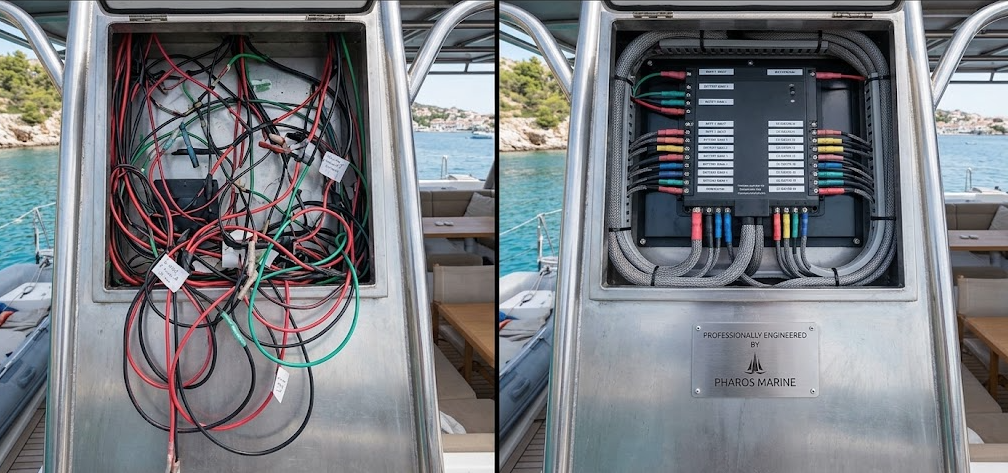
Neat cable routing, proper support and high-quality crimped connections are equally important for long-term reliability.
Building a Complete Victron Energy Ecosystem
One of the greatest advantages of Victron Energy is that every component has been designed to work as part of a complete ecosystem. Rather than purchasing individual products from different manufacturers, users benefit from a fully integrated platform where charging, power conversion, battery monitoring and remote management communicate seamlessly.
A typical modern installation may include:
- Victron MultiPlus-II inverter/charger
- SmartSolar MPPT charge controller
- LiFePO4 battery bank
- SmartShunt battery monitor
- Cerbo GX communication centre
- GX Touch display
- BatteryProtect
- Lynx Distributor or DC busbars
- VRM remote monitoring platform
The result is a system that is easier to operate, easier to expand and significantly easier to troubleshoot if required.
Example of a Modern Off-Grid Marine Electrical System
To better understand how these components work together, let’s look at a typical example.
Example Vessel
40-foot Cruising Sailing Yacht
Typical Equipment
- 600W solar array
- Victron SmartSolar MPPT
- 400Ah LiFePO4 battery bank
- Victron MultiPlus-II inverter/charger
- Cerbo GX
- GX Touch display
- SmartShunt
- BatteryProtect
- Shore power connection
This configuration allows the vessel to operate essential onboard equipment such as refrigeration, navigation electronics, lighting, communication systems and everyday household appliances while significantly reducing generator runtime. Every installation, however, should be designed according to the vessel’s actual energy profile rather than copying another boat’s specification.
Real-World Installations Matter More Than Specifications
Reading product specifications is useful, but designing a reliable marine electrical system requires practical experience.
Every vessel presents different challenges:
- Limited installation space
- Existing wiring infrastructure
- Weight distribution
- Ventilation
- Charging sources
- Future expansion plans
- Owner’s cruising habits
These variables cannot be addressed by product selection alone. This is where experienced marine electrical engineers make the difference.
Common Mistakes We Frequently Encounter
Over the years, many boat owners have upgraded their electrical systems gradually, often adding components as new requirements arise. While this approach is understandable, it can also introduce inefficiencies and unnecessary complexity. Some of the most common issues we encounter include:
Oversized Inverters with Undersized Battery Banks
Installing a powerful inverter does not automatically increase available energy. If the battery bank cannot support the required load, the inverter’s full potential can never be utilised.
Incorrect Battery Capacity Calculations
Battery banks are often selected based on available space rather than actual daily consumption. The result is reduced autonomy and frequent deep discharge cycles that shorten battery life.
Poor Cable Management
Untidy wiring, unsupported cables and poorly crimped connections increase the likelihood of voltage drop, maintenance issues and long-term reliability problems.
Lack of System Monitoring
Without accurate battery monitoring, many owners rely solely on voltage readings to estimate remaining capacity. This often leads to unnecessary battery stress and unexpected power loss.
Mixing Incompatible Components
Combining equipment from multiple manufacturers without considering communication protocols or charging profiles can reduce overall system efficiency and complicate troubleshooting.
Designing Without Future Expansion in Mind
Many installations leave little room for additional batteries, larger solar arrays or future electrical equipment.
A well-designed system should allow for future upgrades without requiring a complete redesign.
Why Professional System Design Makes the Difference
Choosing premium components is only one part of the process.
The real performance of a marine electrical system depends on how those components are integrated.
Professional system design considers:
- Energy consumption analysis
- Battery sizing
- Cable calculations
- Protection devices
- Ventilation
- Heat management
- Future upgrades
- Ease of maintenance
- Compliance with marine installation standards
The objective is not simply to install equipment—but to create a reliable electrical system that performs consistently under real cruising conditions.
Why Boat Owners Choose Pharos Marine
Designing a dependable marine electrical system requires technical expertise, careful planning and practical experience.
At Pharos Marine, we specialise in marine electrical and electronic systems, delivering tailored Victron Energy solutions for recreational and commercial vessels. Every installation is designed around the vessel’s specific operational requirements, ensuring optimum performance, safety and long-term reliability.
Our approach goes beyond supplying equipment. We support every stage of the project—from system design and component selection to installation, commissioning and ongoing technical support. As our portfolio continues to grow, visitors will be able to explore real Victron Energy installations completed by our engineering team, demonstrating how properly designed systems perform in demanding marine environments.
Frequently Asked Questions
Is a lithium battery bank worth upgrading?
For most modern vessels, LiFePO4 batteries offer significant advantages in lifespan, charging efficiency, usable capacity and overall performance compared to traditional lead-acid technologies.
How much solar power does a boat need?
There is no universal answer. Solar capacity depends on your daily energy consumption, available installation space, cruising location and desired level of energy independence.
What’s the difference between Victron MultiPlus and Quattro?
The MultiPlus is suitable for most recreational vessels, while the Quattro provides two independent AC inputs and is commonly selected for larger yachts or commercial applications.
Can I install a Victron system on an older boat?
Yes. Many existing vessels can be upgraded gradually. However, the existing wiring, charging infrastructure and battery configuration should always be assessed before selecting new equipment.
Can I monitor my boat remotely?
Yes. By combining a Cerbo GX with the Victron Remote Management (VRM) platform, owners can securely monitor system performance from virtually anywhere with an internet connection.
Conclusion
A reliable marine electrical system is never the result of selecting a single premium product.
It is the outcome of careful engineering, accurate energy calculations and the seamless integration of batteries, charging systems, inverter/chargers, monitoring devices and protection equipment.
Victron Energy provides one of the industry’s most advanced ecosystems for achieving this goal, offering scalable solutions suitable for everything from weekend cruising yachts to commercial vessels operating in demanding conditions. Whether you’re planning a completely new installation or upgrading an existing onboard electrical system, investing time in proper system design will improve efficiency, increase reliability and provide greater confidence every time you leave the dock.
If you’re considering a Victron Energy installation, working with experienced marine electrical specialists ensures that every component is selected, installed and configured to perform as a complete system—today and for many years to come.